Interview: Erik Wøllo
By: Jorge SergioErik Wøllo is a Norwegian musician and composer, who sails with equal success by the sea of acoustic music, mostly with the guitar, and the many rivers coming from the electronic technology applied to music. With a long and prolific career behind him, he continues to explore new musical paths from the point of view of a visual artist. Because of the release of his latest album, Airborne, he has granted this exclusive interesting interview to articmist.
This interview in spanish here
First of all, Erik, thanks for your time! Your professional music career began in 1980, but how were your first steps into the world of music? Did you learn on a Conservatory or you are self-taught?
I started to play the guitar when I was eleven years old. Played in local bands, and continued to discover all the great music in prog rock and fusion in the seventies. Gradually I wanted to work more on composition, and began to explore the electronic music as well. I am basically self taught. I started on an University education, but I was too busy touring.... Also the music I wanted to work on at that time was not much recognized in the higher education systems, there were very few places you could study it. Music that had elements from all genres, and that was rhythmically based. And using all the modern technology, that became more and more sophisticated every year. No school could cope with that. When I look at it now, an education would not have been very important. In fact it would just be a big confusion to me, since I have always focused on finding my own style in music, and I like to study on my own.
During all these years you have recorded music for films, ballet, theater ... Do you consider yourself musically multifaceted?
I am a Multitrack person! I kind of walk on the beach collecting pieces on the way, finding elements that I can use later in my collage. Instead of just collecting the round stones, I find those odd shaping ones interesting too! I have always been interesting in working together with other media. Especially in the visual field. In fact if I had not become a composer, I would have been a visual artist. Combining the two, often makes a third and new dimension, which I find very interesting. And working with choreographers has also been very inspiring. Modern dance is probably the art form that is closest to the musical language. Using time and space to form an expression.
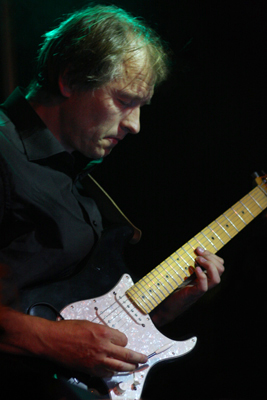
Actually, what I really know about your music, focuses on a mix of acoustic instruments with electronics, which I find fascinating. What was your first instrument?
As mentioned, I started playing the guitar at eleven. That was the coolest thing to do at that time, and it still is! I do not consider myself as an electronic artist only. I have done two acoustic guitar albums Guitar Nova and Blue Sky Red Guitars. I have a plan on doing another guitar album soon. It is all about the harmonic spectrum. Electronic instruments can often have a very limited overtone spectrum, and therefore their sound is often narrow. Mic up an acoustic instrument and it gives you a total different sonic experience. And we can certainly hear those harmonics over the 20.000 kHz! So I always look for a way to make the arrangements as organic as possible. Mixing acoustic and electronic instruments together is challenging, but something I find interesting and something I want to develop further.
So, guitar is a very important element of your music production. I think that you have a very unique and special style... Is there a Wøllo Style of making music?
The guitar is the "eye" of my music. Most of my music has that special unique touch with those special guitar elements. I have spent a lot of time developing my guitar concept, refining my guitar technique as well as finding the right equipment. But it depends on what I want do do, some pieces do not have any guitars at all.
Second to the human voice there is the stringed instruments and blown instruments that gives the most human touch. Keyboards and percussion instruments will always be more abstract, and further away from the body. Because of their nature, they are not so direct. I try to combine these elements, depending how abstract I want the music to be. I also spend a lot of time creating my own sounds and patches on my synthesizers. When I get a new synth, I through out all the factory presets and start to create my own. It does not need to be that many sounds, just 10 or 20.
I've always liked the musician who composes and produces his own music, as you are ... Maybe the final result shows more of the person behind the music than a project where several musicians are involved. Do You think so?
Yes, I think working alone is the key to develop something unique and personal. But this way of working is not suited for everyone, of course. Depends on your personality. Traditionally musicians have been playing together in groups. And traditionally opposite, painters for example, have always been alone in their studios.
With the modern studio technology, musicians can now work alone like a painter. That suites me very well. But it is challenging. You have to be able to be subjective, but at the same time also you must have the ability to have an objective and distant overview of your art.
However, you have collaborated with other musicians and artists. Have you composed for symphony orchestras, quartets or perhaps for chamber orchestras?
Sometimes it is very important to go outside of your studio, meeting the real world and getting out of your comfort zone. And be able to write for other musicians is a real pleasure. The end results will often be surprising, and you get a lot of creative inputs. I have written a lot of music for other ensembles and musicians. Like sinfonietta, string quartets, wind quintets, and so on.

I can't avoid asking you about your collaborations with some musicians who are well-known to the readers of articmist, as Steve Roach, Ian Boddy, Frank Van Bogaert, Bernhard Wöstheinrich among others... Did you focus your way of composing in a different way when working with them? Were they enriching experiences?
Working with other artists has been a very important thing for me to do in the latest years. Working with artists that have their own unique style and their own way of working. The main idea behind these collaborations has been to be able to create something completely new, out of a common melting pot with two different kinds of esthetiques. It is important to be open minded and to be willing to give and take. And you have to be able to adapt, and you may have to choose some different ways of working than you usually do. And that is very enriching! All these projects have run so smoothly! And to be able to be together in the studio, just letting the energy flow will often really create something special. And we use the internet of course, exchanging files. When I listen to these albums, the most interesting pieces are the ones in that I can not remember who did what in the various parts and tracks. Pieces that really emerged, and turned into a new unique style.
You create fantastic music, with a latent spirituality, adding guitar, but also you do very rhythmic themes, with arrangements close to techno and strongly electronic oriented. I am also aware that I have not had a chance to listen to all of your work, covering undoubtedly other musical forms ... How can you be so versatile? Have you been "drinking" from multiple musical influences?
Well, I listen to the world around me. And I listen to music that is often very far from my style and genre. You can say, it is all about surfaces. Music is about frequency and time. Scales forming melody or chords. Using short tones, long tones, performed and organized in a time line. The next step is choosing and arranging instruments. Which will point out some esthetique values. And then choose how concrete and how abstract you want your music to be. Beneath this surface you will find the source to all music. I wanted to clearly explore this when I arranged Computerlove and In The Hall Of Mirrors by Kraftwerk for acoustic guitars (on Blue Sky Red Guitars). I took this extreme electronic pieces and transferred them into an acoustic world. But keeping as close to the originals as possible. Also I have been playing and studying various ethnic music from other parts of the world. Exploring the basic elements in music. A pygmy tribal chant from Africa is not that far from some of the modern techno music! I think I write on the same piece of music all the time. Just changing the surface.
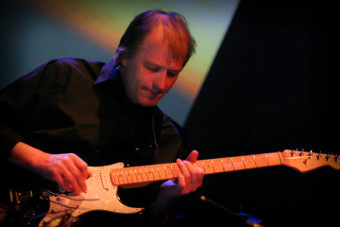
How are your live performances?
For my regular solo shows I do special arranged versions of some of the material from my albums. Also I play a lot of unreleased material, specially written for the certain concerts. Also I focus more on the guitar in a live situation. So you will always hear more of the guitar sounds when I play live. This way I can give the music a more spontaneous feel, performed there and then on stage. Every concert have a special unique build set. All very composed. I make a special video background, that will run as a meditative decoration behind me on stage. I am a very visual person, photo and art is equally important to me as the music.
I recently did a duo concert with Ian Boddy in Germany. That was very inspiring and we played most of the material from our album Frontiers. But we arranged the songs specially for that concert. There is no point in perform the exact versions that you find on the albums. I also have a quite different live set up where everything I play is improvised. With loops and soundclips that I arrange together in real time, playing guitar and keyboards on top. My double live album Silent Currents is done this way, derived from two live performances done in Philadelphia, USA. This is something I rehearse on every morning, before doing anything else. Rehearse to improvise.
You have designed your own VST's ... Do you use in your studio and we can listen to in your recordings?
I remember that I used them a lot on my album Elevations. I started to use VST synths very early, when they became available. Since I began to build my own studio back in 1984, I always had a vision of a complete studio setup inside of a small portable box! Now we are there, you can do a total high end production inside of your laptop!
For those interested in virtual music technology... Can you describe the characteristics of your VST's?
Those VSTs have really become a huge success. Since I made them in 2006, they have been downloaded several hundred thousand times, about 3000-4000 every month! This has been a real nice way to build a fan base for my music as well. They are all free, except my Wøllo Voyager. Soundwise they are designed to fit my music and esthetique, focusing on textures. And they are easy to melt in together with the rest of the instruments in a mix.
Besides you use often a lot of music technology ... Do you like analog synthesizers? Did you ever used?
Beside of using VSTs, I always have used analog equipment. So there is always a mix with software and hardware in my music. Nothing (still) compares to high end hardware. Especially in the fx department, like reverbs and so on. In my studio, I still have my old analog synths from the 80ties and 90ties available. The thing is to know each element in your studio very well, knowing where to use them in your music. Every piece of equipment has their own character. Like the Mini Moog is good for bass sounds, and so on.tc.
I sometimes ask to the musicians about what inspired a theme or a particular disk ... I've always liked your work Transit, which contains several very rhythmic and electronic tracks. Do you remember what inspired you? More particularly ... How was the approach to the piece Poles?
That is really feels long ago! I started to work on Transit around 1994. I think I choose the title Poles to kind of picture a journey to the remote outposts on the globe. Transit is my most techno rhythmical influenced album, and some of the tracks have almost a pop feel. Since then I have left this way of building the rhythmic patterns. Returning back to focus more on the deeper ambient elements, like I had developed on Images of Light, Solstice and Traces. Music that is more challenging and adventurous, and with a pastoral and rural character.
Your new job is entitled Airborne, published in the American label Projekt Music (your two previous albums, Gateway and Silent Currents were also published in this same label, specialized in darkwave and ambient music. Would you describe this album to people who might be encouraged to listen to Erik Wøllo for the first time?
Airborne is my latest album and has already got lots of positive reviews. A great one that encourages people to discover my music here: http://www.starsend.org/Airborne.html This review from Chuck Van Zyl really nails it all down, and he describes the music in a very exact way.
Well, this album is the first one that I made in my new studio on Hvaler in Norway. It is an island south in Norway, a very nice and quiet place. I guess the album has most of the typical Wøllo elements. But I feel it is even more refined than my previous recordings. All the tracks flow naturally into each other, almost forming a complete suite. It is recommended to listen to the whole album in one take. And the whole album has an organic acoustic feel, although most instruments are electronic.
Are you working on future projects?
I am Always working on new material. There will be a new mini album available (as download only) in November called Crystal Bells. Music made for the winter season!


